|
We
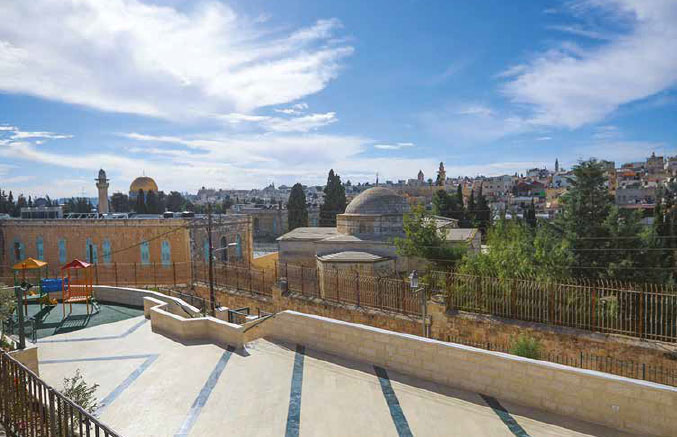
walk through the narrow alleys of the Old City of Ramallah, alongside women in
loose white scarves and embroidered Palestinian thob*, children well-dressed, men with checkered kufiya or hair gelled back, some playing
chess or barcges**, some running,
some chatting, some arguing, reading the newspaper, greeting, laughing, gazing
in the distance on a hot sunny winter day. Aromas of musakhan*** fill the air. Sounds float over the ginger rooftops.
Voices sing and echo vibrating strings of violins (kamanjat), guitars, buzoks**** and the whistling resonance of
flutes and harmonicas. Smells, sounds and structures play in complete harmony.
Nestled
alongside the houses, grocery shops, cafes, bakeries, a mosque and a church, Al
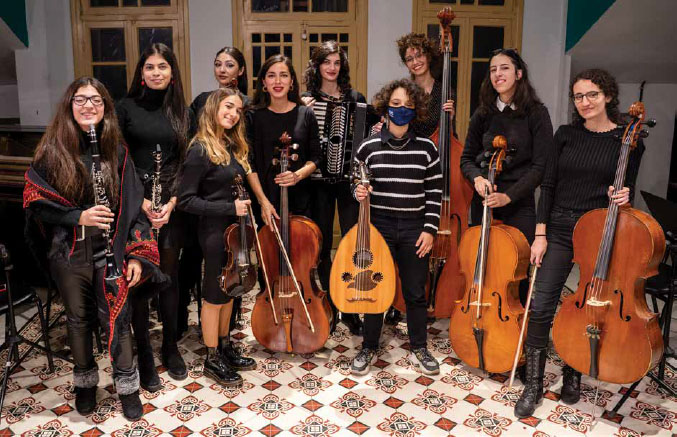
Kamandjati (The Violinist) Music Center has become part of this place, its
surroundings, its people. The idea to establish a center for music education in Ramallah started with an extensive touring music program for children in
Palestinian refugee camps. It became a reality with the renovation of a
beautiful old building in 2005. “It was a great challenge for us to locate here
in the Old City, but we were pleasantly surprised that people readily accepted
the idea,” said Saed Karazoun, Al-Kamandjati co-founder.
We
enter through the heavy brown metal door with raised golden dots. The air has a
sense of liveliness and calm at the same time, music reverberating. A girl
leans against the rough stone wall reading musical notes. Boys sit on
sculptured squared rocks talking and laughing. An old violin rests in the nook
of a stairway leading to an administrative office.
Director
Ramzi Abu Radwan, who grew up in Al-Amari refugee camp in Ramallah, brought his
vision to reality with the creation of Al Kamandjati. After studying violin in
France, he founded the Center to bring music instruction to the most vulnerable
Palestinian children, who are devoted to learning music but lack access due to
financial limitations and social obstacles. Al-Kamandjati offers lessons at its
Old City center, as well as other locations in the West Bank, Gaza and southern
Lebanon.
Saed
Karazoun, 24, the energetic music instructor and program coordinator, explains
that the Center’s goals are not solely music education, but raising cultural
and social awareness for the children and their families.
The Students: Self-esteem,
Persistence and Team Work
The
whispers and giggles of young musicians, the harmonies of their music…
The
children of next door neighbor Um Shehadeh attend classes at Al-Kamandjati.
Ala’a, 11, is a violinist and Shehadeh is a violinmaker. Ala’a began playing
violin at age 7. “The violin is an animate instrument filled with emotions and
feelings,” she said. Her dream is to teach music.
Carrying
the violin on her back, it almost reaches Ala’a’s feet. Many girls from her
school joined the Center after seeing her carrying her violin. Her best moment
was “when she went to Italy last year and played the violin in front of
hundreds of people. We represented Palestine!” she added.
It
is not standing on the stage or hearty applause that makes Ala’a smile,
however, but the insistence of love, music and life. Sadly, Ala’a recalled the
story of her journey to Nablus: “We were going to perform at a concert. At the
checkpoint, Israeli soldiers checked my violin case. Another student forgot his
ID card. We were forced to wait more than an hour, so we arrived late. Some of
us were still afraid and we didn’t play as we originally practiced. Sometimes I
feel that the Israeli occupation doesn’t want us to play music, but we are
playing anyways.”
From
a young age her brother Shehadeh has loved making and fixing things. With
Kamandjati’s support, he made his first violin at 17. And next summer he will
be attending the Newark School of Violinmaking in London.
Ahmad
and Maroun became fast friends through Al-Kamandjati. Ahmad, nine, who attends
an UNRWA school for refugees, joined the center when he was six. He began with
the flute, but when “(his) front tooth was broken, (he) shifted to the violin… I
love playing it,” he said. Though his family moved away from the neighborhood,
he keeps coming back to al-Kamandjati. He hopes to become a professional
violinist one day.
Ahmad’s
friend Maroun, 11, attends private school. He sings and plays the guitar, for
which he won the Marcel Khalifeh prize in his category. “It’s as if I’m coming
to my own home,” says Maroun with confidence, his dark hair hanging over sleepy
eyes. He loves the building and the neighborhood. “I thank my parents from the
bottom of my heart for letting me be here. I feel as though I’ve done something
important with my life.”
And,
there is Odai, 17, perhaps the poster child for Kamandjati’s philosophy that
music requires discipline, commitment and responsibility. Odai, from al-Fawarah
Camp near Hebron, was 12 when he approached Ramzi at a Kamandjati workshop in
Hebron. “I went right up to him and told him that I could sing.” Odai recorded
his first CD two years ago and has toured internationally. He dreams to be a
famous singer. For now, he knows that he must focus on the tawjihi, his secondary school matriculation studies, but he never
misses a lesson at al-Kamandjati.
The Teachers: Love, Care and
Support
Saed
Karazoun, 24, the energetic music instructor and program coordinator, explained
that children have learned through participation to listen, respect and
understand the value of teamwork. At concerts where everyone used to be
chatting and answering cellphones, they are now fully concentrating: “As the
music begins, children and families are all in full concentration,” he said.
Saed offered another promise: that Al-Kamandjati has allowed children to
present their country to the world to better communicate the Palestinian cause.
“We are a big family here.”
Saed
met Al-Kamandjati Director Ramzi Abu Radwan in 2003, after having studied oud at the Fine Arts Institute in
Ramallah for 11 years, where he was learning to accompany his father, a popular
singer. Saed and Ramzi shared a passion: to make music available for all. They
organized music workshops in every possible camp and village until their
voluntary efforts evolved a full-fledged music center.
Celine
joined the staff after she met Ramzi at a concert in France. For her the
process of watching children change and develop is exciting as they become
committed to their art, to each other and they become confident and proud.
Since
Welfare Association’s support for the “Music for All” project, Al-Kamandjati
has been able to sustain its level of academic teaching. Within four years, the
organization has expanded to four cities, teaching more than 350 students in
four refugee camps. It is aiming to further expand, preserving Palestinian
identity and heritage through music. “The aim is not to make the students
international and professional players, but to focus on the importance of the
general cultural atmosphere,” said Saed. Music, he said, is a way to develop
psychological and social skills, a sense of self-expression and collective
identity. Even as Al-Kamandjati preserves Palestinian heritage and builds the
future of the country’s culture, children like Ahmad, Ala’a, Maroun, and Oday
will hopefully achieve their dreams and find their hopes in a brighter future.
----------------------
*Traditional
Palestinian dress filled with cross-stitch embroidery.
**A
Syrian game with square cloths, inlaid (?) boxes and 12 shells, played in two
teams.
***A
Palestinian national dish made of roasted chicken, onions, sumac, saffron and
fried nuts on layers of taboon bread.
****A
small long-necked lute of the Middle East, made from separate ribs, glued
together, played with 3 x 2 metal strings.
This article was collectively
researched and written by Welfare Association employees Marah Abdelhadi, Lina
Bokhary and Deema Ershaid, all inspired by their visit to Al-Kamandjati.
|